
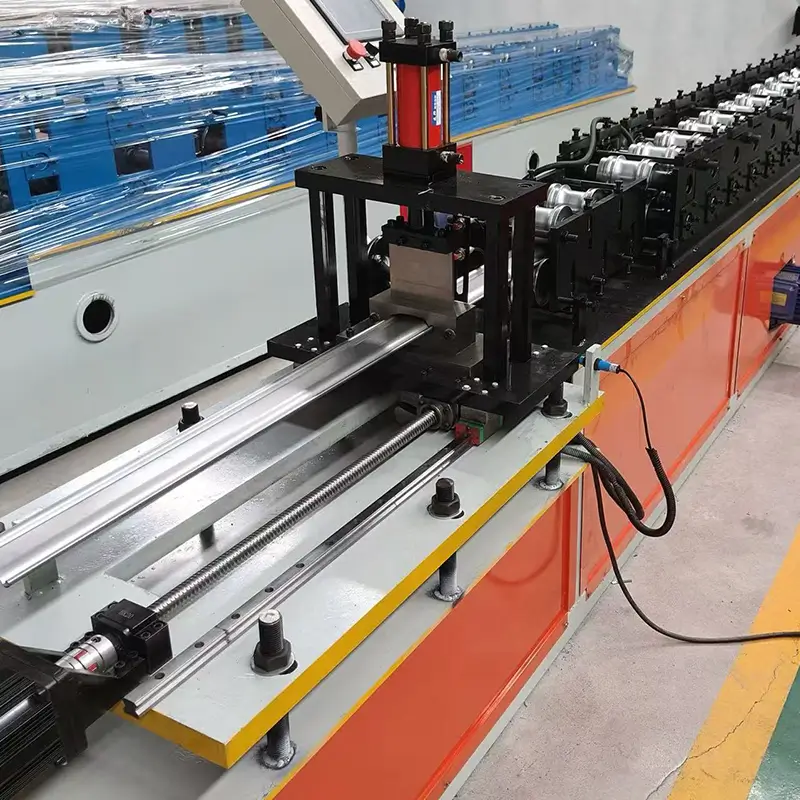
Rolling Shutter Door Roll Forming Machine
High‑speed forming, PLC automatic control
- CE / ISO9001
- 0.3–1.2mm thickness
- Interlocking edge design
- 15+ years experience
Tel:0086 15194755533
Email:dtrollformingmachine@gmail.com
Product Overview
The Rolling Shutter Door Roll Forming Machine is a high-efficiency cold roll forming system designed specifically to produce metal slats (curtain panels) for rolling shutter doors. These interlocking slats are the primary components of rolling shutters—used extensively for commercial shop fronts, industrial warehouse doors, garage doors, and security enclosures.
This machine processes galvanized steel (GI), pre-painted steel (PPGI), aluminum, or stainless steel coils into precisely shaped slats with consistent curvature, interlocking edges, and smooth surface finish. The machine integrates decoiling, roll forming, optional punching, hydraulic cutting, and automatic slat stacking into one continuous production line, delivering hundreds of linear meters of finished slats per shift.
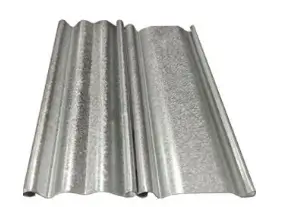
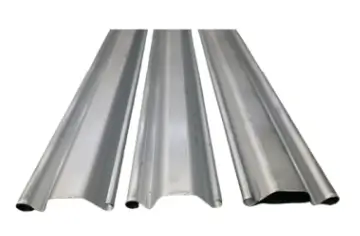
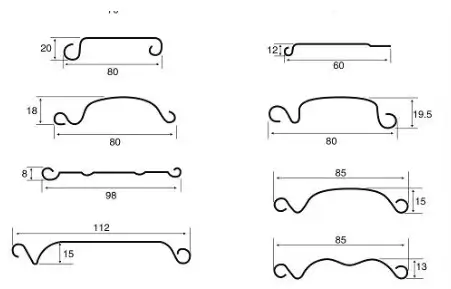
Rolling shutter door slats typically feature a curved profile with interlocking hooks on both ends. When assembled, multiple slats hook together to form a flexible, roll-up curtain that coils around a barrel at the top of the door opening. The machine can produce various slat profiles—standard curved (C-shape), flat (box-type), mini (narrow), industrial heavy-duty, insulated (with foam filling groove), or custom designs based on your drawing.
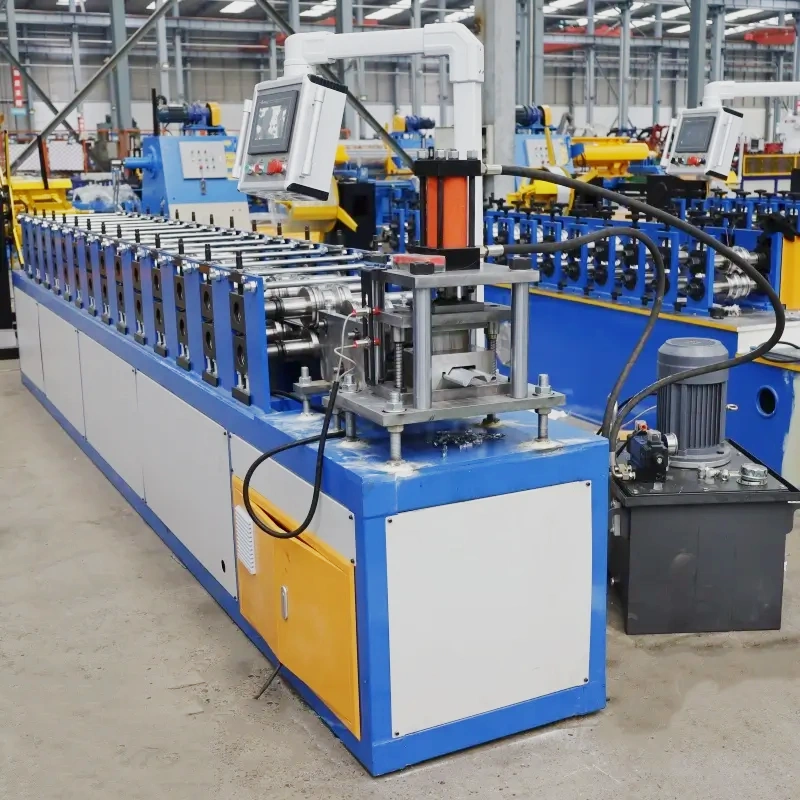
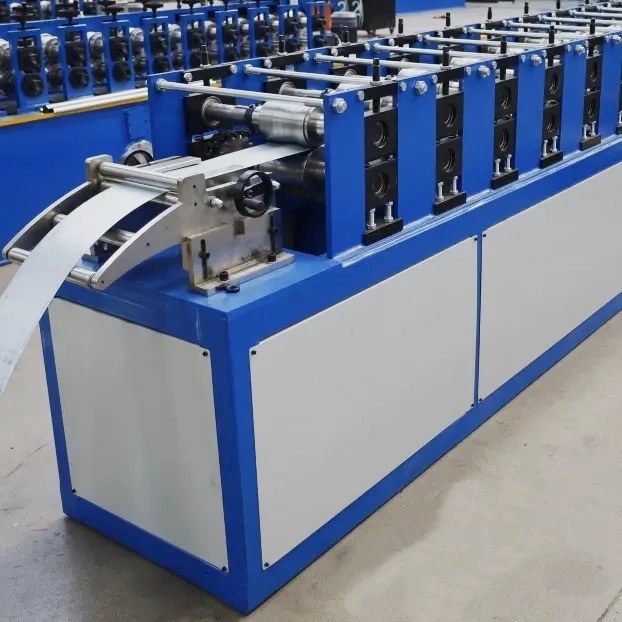
What Is a Rolling Shutter Door Slat?
A rolling shutter door slat is a curved or flat metal profile with specially designed interlocking edges. Multiple slats are connected side by side to form a flexible curtain that rolls up around a drum at the top of the door opening. These slats are the main components of rolling shutter doors used in commercial buildings, shops, garages, warehouses, and industrial facilities.
- Interlocking design: The male hook on one slat engages with the female hook on the adjacent slat, creating a secure and flexible connection for the rolling shutter curtain.
- Curved or flat profile: Common rolling shutter door slat profiles include C-shaped, flat box-type, narrow mini profiles, and heavy-duty industrial profiles, depending on the required door application.
- Guides and end components: Side guides keep the slats properly aligned during operation, while the bottom slat can be equipped with a bottom bar and rubber seal for smooth and secure closing.
Typical slat dimensions: Material thickness ranges from 0.3–1.2 mm, with typical coverage widths of 50–150 mm and profile depths of 15–75 mm, depending on the slat design and application.
Rolling Shutter Door Roll Forming Machine Technical Specifications
| Specification | Standard Range |
|---|---|
| Raw Material | GI (Galvanized Steel), PPGI (Pre-Painted Steel), Aluminum, Stainless Steel |
| Material Thickness | 0.3–1.2 mm (light-duty: 0.3–0.6 mm; heavy-duty: 0.8–1.2 mm) |
| Coil Width (Feeding Width) | 100–500 mm (depending on slat height and profile) |
| Slat Height / Profile Depth | 15 – 75 mm (typical: 20mm, 25mm, 35mm, 50mm, 75mm) |
| Slat Coverage Width | 50–150 mm (after forming) |
| Profile Types Supported | Standard C-shaped, flat (box-type), mini (narrow), deep industrial, insulated (grooved), and custom profiles |
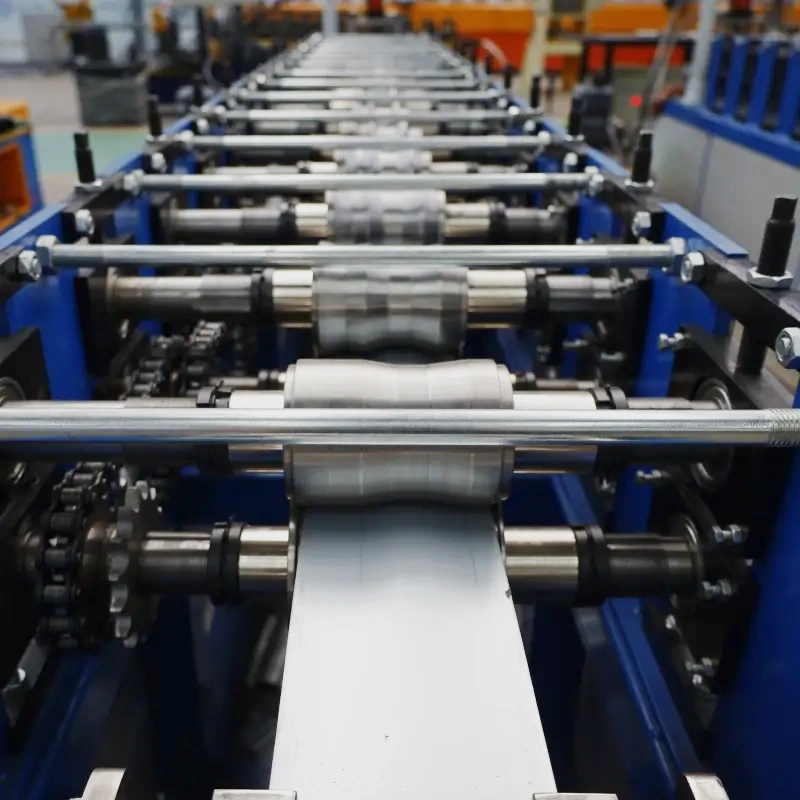
| Forming Stations | 12–22 forming stations |
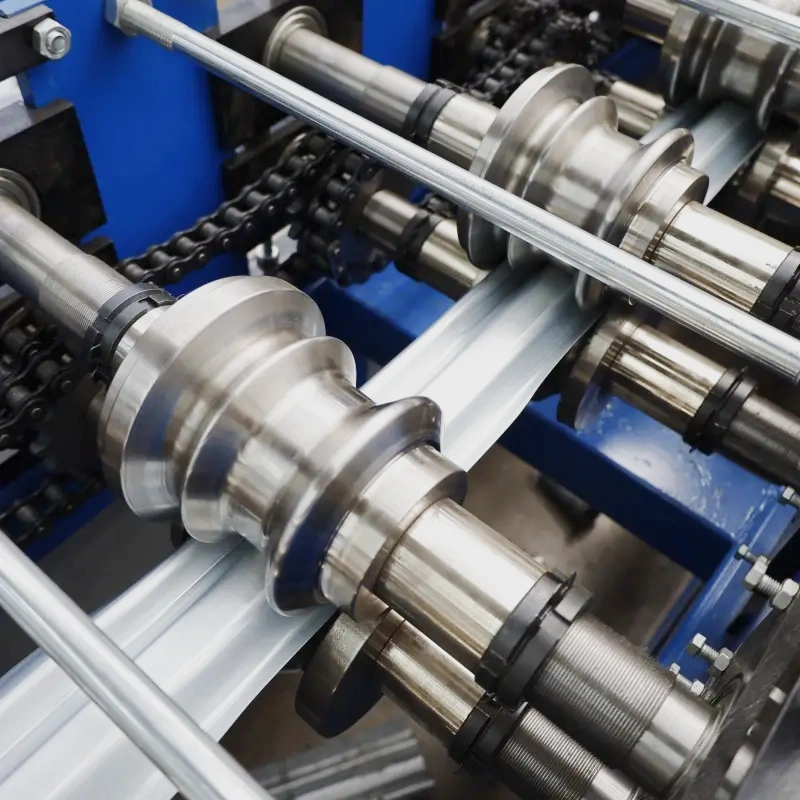
| Roller Material | 45# steel / GCr15 bearing steel, hard chrome plated, HRC 58–62 |
| Roller Processing | CNC precision machining, vacuum heat treatment, hard chrome plating (≥0.05 mm), and mirror polishing |
| Main Shaft Material | 45# forged steel, quenched and tempered / 40Cr |
| Main Shaft Diameter | Φ55–Φ75 mm |
| Main Motor Power | 3–11 kW |
| Forming Speed (Standard) | 8–20 m/min |
| Forming Speed (High-Speed) | 20–35 m/min (optional, for simple profiles) |
| Drive System | Chain transmission (1–1.5 inch chain) or optional gearbox drive |
| Cutting System | Hydraulic post-cutting (stop-cut) or electric flying shear |
| Cutting Blade Material | Cr12 / Cr12MoV, quenched to HRC 58–62 |
| Cutting Length Tolerance | ±1.0–±2.0 mm |
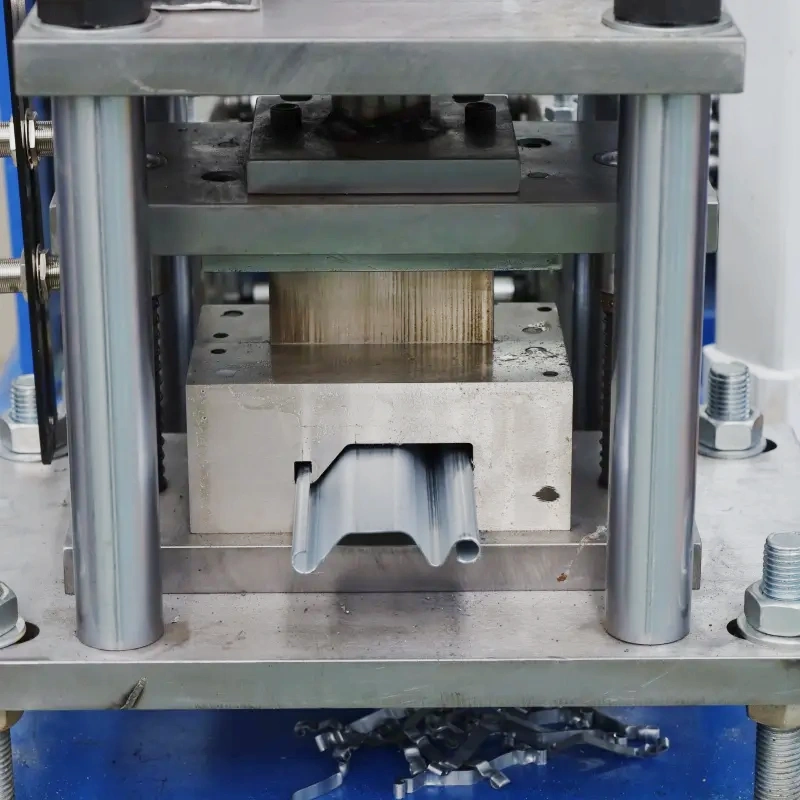
| Punching Unit (Optional) | Optional hydraulic pre-punching for end slots, lock holes, and screw holes |
| Automatic Stacker | Optional, for automatic stacking of finished slats |
| Control System | PLC (Mitsubishi, Panasonic, Siemens, or Delta) + HMI touch screen |
| HMI Features | Recipe storage, multilingual interface, production monitoring, and fault diagnosis |
| Voltage / Frequency | 380 V / 50 Hz / 3 Phase (customizable to 220–480 V, 50/60 Hz) |
| Machine Dimensions (L×W×H) | Approx. 5,500 – 8,000 mm × 1,000 – 1,300 mm × 1,200 – 1,500 mm |
| Machine Weight | Approx. 3–7 tons |
| Warranty | 24 months for the main structure and rollers; 12 months for electrical components |
| Certification | CE marking; ISO 9001 quality management system certification |
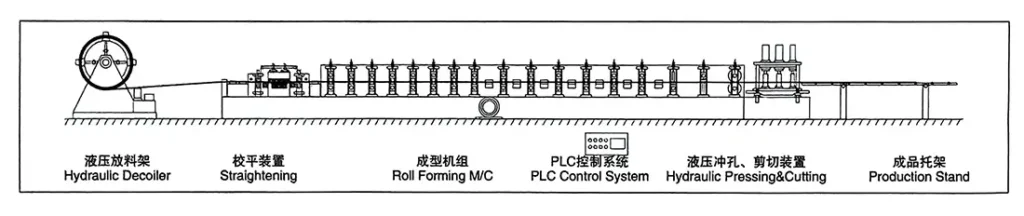
Production Workflow Diagram
Small Decoiler → Feeding → Roll Forming (10–16 stations) → Length Setting → Hydraulic Cutting → Output Table (or Automatic Stacker)
Key Features & Benefits
1. Specialized Slat Production
The machine is specially designed for producing rolling shutter door slats with accurate interlocking hook profiles. Precision-machined forming rollers ensure stable engagement between male and female hooks, improving the consistency and durability of finished shutter curtains.
2. High-Speed Continuous Output
Standard production speed reaches 8–20 m/min, with up to 35 m/min available for simple profiles. The automatic production line integrates decoiling, roll forming, cutting, and stacking, reducing manual operation requirements and improving production efficiency.
3. Precision Rollers for Consistent Interlocking
The rollers are made of 45# steel or GCr15 bearing steel, heat-treated to HRC58-62 and hard chrome plated. This ensures long service life, smooth forming performance, and accurate slat interlocking during continuous production.
4. PLC + HMI Intelligent Control
The PLC and HMI control system allows operators to set production parameters, cutting length, and batch quantities easily. Real-time monitoring and fault diagnosis help improve operation stability and reduce downtime.
5. Optional In-Line Punching
Optional hydraulic pre-punching units can create end slots, lock holes, or screw holes before forming. This integrated process reduces secondary processing and improves overall production efficiency.
6. Automatic Stacking (Optional)
Finished slats can be automatically counted, aligned, and stacked, reducing manual handling and protecting finished profiles from damage.
7. Versatile Profile & Material Compatibility
Supports various rolling shutter slat profiles, including:
• Standard curved (C-shape) – widely used for commercial shops and warehouses
• Flat (box-type) – suitable for economical light-duty applications
• Mini (narrow) – suitable for compact garage and residential doors
• Industrial deep profile – suitable for large industrial doors and wide openings
• Insulated (with groove) – designed for inserting insulation materials to improve thermal performance
8. Quick Changeover Between Slat Types
Changing between different slat profiles can be achieved by replacing the roller tooling or cassette. Optional quick-change designs are available to reduce adjustment time and improve production flexibility.
Rolling Shutter Door Slat Samples and Applications
FAQ – Rolling Shutter Door Roll Forming Machine
What slat widths can your machine produce?
Our standard rolling shutter door slat widths include 75mm, 80mm, and 100mm. Customized profiles from 50mm to 120mm can also be produced according to your drawings or requirements.
What material thickness is required?
The machine can process galvanized steel, pre-painted steel, aluminum, and stainless steel with thickness ranges from 0.3mm to 1.2mm, depending on the slat profile and application.
Can the machine process pre-painted steel (PPGI)?
Yes. The rolling shutter door roll forming machine is suitable for galvanized steel, PPGI, aluminum, and stainless steel coils. The precision rollers ensure smooth forming without damaging the surface coating.
How do rolling shutter door slats connect together?
The slats are designed with interlocking hooks on both sides. During assembly, each slat connects with the next one to form a flexible curtain that rolls up smoothly around the door drum.
What is the production speed of the machine?
The standard forming speed is 8–20 m/min, and high-speed models can reach up to 35 m/min depending on the slat profile and configuration.
Can you customize the machine according to our drawings?
Yes. We provide customized rolling shutter door roll forming machines according to customer drawings, slat dimensions, material requirements, and production needs.